
I’ll never forget Sarah. Sarah was a young woman who sought me out for guidance and support during a very troubling time. She had had sexual intercourse for the first time. Not only was she devastated that afterward the guy revealed that he didn’t really like her as much as she liked him, but also she was nervous about being pregnant. They had had unprotected sex.
As her rabbi, I held Sarah’s as she waited for the at-home pregnancy test to reveal its results. (Thankfully, it was negative.) As her rabbi, I counseled her about opening up to her mother. As her rabbi, I urged her to learn more about contraception and make an appointment either with her gynecologist or at the local Planned Parenthood. Thankfully, those services were available to her.
As a woman and a Jew I am committed to protecting the rights of women everywhere to make their own decisions about their bodies. As a woman and a Jew I am committed to protecting the rights of women everywhere to make their own reproductive choices. This is why I have endorsed the Religious Institute’s new Open Letter to Religious Leaders on Family Planning.
I am deeply honored to have been amongst the dozen Christian (mainline, Evangelical and Roman Catholic), Jewish and Muslim theologians that created the Open Letter. In a day of dialog and discussion, together we affirmed that, “in a just world, all people would have equal access to contraception. The denial of family planning services effectively translates into coercive childbearing is an insult to human dignity.” Together we called on hospitals and health services, regardless of religious affiliation, to provide or refer to contraceptive services. And together we urged religious leaders to “advocate for increased U.S. financial support for domestic and global family planning services.”
Our Reform Movement has long been at the forefront of supporting family planning and women’s reproductive rights. As far back as 1935 the Women of Reform Judaism passed a resolution expressing support for the lifting of bans on the dissemination of birth control literature. Each of the major advocacy voices of our Movement (the URJ, the CCAR, and WRJ) have regularly reaffirmed their support of women’s reproductive rights and commitment to women’s reproductive health every time the issue has arisen in political debate. We have not backed away from our Movement’s support of this critical issue.
Once again, we are debating about a woman’s access to accurate reproductive health services and contraception. We must let our nation’s leaders know how we feel. As Reform Jews, we must resist those who would deny individuals the ability to make their own personal decisions about their families and reproductive lives. As the Open Letter states, we must “oppose any attempt to make specific religious doctrine concerning pregnancy, childbirth, or contraception the law of any country in the world. Religious groups themselves must respect the beliefs and values of other faiths, since no single faith can claim final moral authority in domestic or international discourse.”
If you are Jewish professional, please add your name to the list of endorsers by clicking here. If you are a member of a congregation, please ask your congregational professionals to add their name and express your own support by joining the Faithful Voices Network. Let us demonstrate to all who would once again limit contraception that people of faith understand that “contraception saves lives, promotes human flourishing, and advances the common good.”
Note: You will also find this cross posted on the RACblog.
Catching up on my New York Times Magazines this week, I came across this poignant piece by David Sax about the power of food in family relationships: Last Bites
I don’t know if it is true for all families, but food definitely plays an important role in our family.
In the Novak family (my family of origin), we are known to talk about dinner plans while we are still sitting at the breakfast table. My mom has hundreds of pictures of us sitting together a dinner tables around the world, at numerous holidays and family simchas (celebrations). And we tell stories over and over about amazing meals we have had together.
The Winer family (the family I am blessed to have married into 20+ years ago) has similar traditions. Most beloved of Winer family stories are those that are about Grandpa Cohen’s cooking adventures. Sax’s piece as well as a sweet email exchange I had with Saul this week reminded me of this story.
Rick and I were newly married, living in Los Angeles while studying at HUC. Rick’s grandparents, Grandma and Grandpa Cohen lived in the San Fernando Valley and we tried to see them weekly, usually on Sundays. Grandpa loved to cook. He had worked for decades as a restaurant supplies salesman. It was a source of great family pride that Grandpa Cohen supplied Tommy’s with the chili powder for their world-renown chili burgers. Grandpa didn’t follow recipes though. He would just tinker in the kitchen, figure out what worked, and voila, out would come a delicious meal.
One Sunday we arrived to the smell of something delicious in the oven. When it was time to eat, Grandpa brought out this yummy looking enchilada casserole. Grandpa Cohen didn’t keep kosher and neither did we. Biting into the casserole we realized this was no normal enchilada casserole.
“Grandpa,” Rick asked, “what’s in this?”
“Hotdogs, honey. I thought they would taste good.”
Rick and I looked at each other, chuckled, and continued eating.
Since then we have told this story to our children hundreds of times. Anytime I make enchilada casserole (which is often because it’s a family favorite), Max asks if it has hotdogs. It usually doesn’t. I haven’t ever actually recreated Grandpa Cohen’s creation.
This week, Saul, who is off at college and living off campus for the first time, emailed me asking for my enchilada casserole recipe. I typed it up and sent it to him:
Saul –
You can get all of these items at Trader Joes. I hope I get the amounts correct – it’s not a big deal if I don’t. You just layer it all up and bake it till its yummy.9 corn tortillas, sliced in half1 jar tomatillo (green) salsa1 cup sour creamshredded mexican blend cheese1 bag of the frozen brown rice (it comes in a box with 3 bags in it. You can use white rice too)1 pkg “just chicken” slices – its in the refrigerated prepared foods section, near the salads etc.Mix the salsa and sour cream together.Lightly grease a 9×13 pan. Preheat oven to 350 degrees.To create the layers –Pour about 1/4 of the salsa mixture into the bottom of the pan. Spread it around to cover the bottom of the pan.Layer 3 tortillas – (6 halves) to cover the bottom of the pan.Add 1/3 of the chicken, 1/3 of the rice and sprinkle a handful of cheese over it.Pour 1/4 of the salsa mixture.Layer 3 more tortillas (6 halves)Add 1/3 of chicken, 1/3 of rice and another handful of cheeseLayer last 3 tortillasAdd last 1/3 of chicken, last 1/3 of rice and the final portion of the salsa mixture.Finish with some more cheese – I usually do 1-2 handfuls for the top so it is moist and cheesy,Place in the oven and cook until it is all warm and the cheese has melted, about 20-30 min. (I don’t remember how long exactly so just watch it.Enjoy!xoxoxox – Mom
How much do you think would it affect it if I switched the chicken for hot dog slices? =P
I opened my email this morning to some sad news. My rabbi, Akiva Annes, passed away.
In my life I have been blessed to have several people whom I can call “my rabbi.” Rabbi Annes came into my life at time when most young adults walk away from their congregation – after high school. A combination of his wisdom, attention to the young people in the congregation, and my already strong commitment to Jewish learning helped bring us together.
Learning about his passing, I was immediately drawn to two memories of Rabbi Annes.
Memory #1
As a senior in college, I was seriously considering the rabbinate as a career. In fact, I was just beginning the application process. During one of my initial conversations with the admissions staff at the Hebrew Union College-Jewish Institute of Religion, I was challenged to consider whether or not the rabbinate was the right direction for me. At the time, I did not want to be a “pulpit rabbi.” At that time, it was more difficult for potential a rabbinic student to shape an alternative rabbinate before ordination. It was just assumed that all of us would become congregational/pulpit rabbis. I went to Rabbi Annes for guidance. I shared my fears, my frustrations, my dreams and passions with him. He of course supported me. He helped me recognize the gifts I have and that there was ample room for them in the Jewish community, no matter what path I chose.
Memory #2
A brief two years later, much had changed in my life. I was a rabbinic student at HUC-JIR. I was engaged to be married to Rick. We had completed our first year of studies in Jerusalem and were returning back to Los Angeles to get married. Rabbi Annes was going to be our lead officiant at the wedding (along with my cantor and two other rabbis). Rick and I made a date to meet with Rabbi Annes to discuss the ceremony. With all of our entering-2nd-year-of-rabbinical-school-wisdom we had some very clear opinions about how we wanted the ceremony to be shaped.
“Rabbi Annes,” I said, “it is very important to us that the ceremony be very egalitarian. We want to use gender neutral God-language. I will not be circling Rick 7 times. We want to say the same vows to each other.”
Rabbi Annes smiled knowingly. On the one hand, I think he humorously enjoyed our passion, our misplaced sense of rabbinic wisdom. On the other hand, I wonder if he was thinking “Who in the hell do these kids think they are? Do they think I’ve never done a wedding ceremony before?!” But he didn’t let on.
Come the night of the wedding. We are standing under the chuppah (beautifully made by Akiva’s wife Shoshana). Rings and vows and Sheva Brachot (Seven Blessings) have been said. Its time for Rick to step on the glass. Before placing it on the floor, Rabbi Annes pauses. “Laura,” he says, “Wrapped in this napkin is not just one lightbulb, but two. One for each of you.” There was a sparkle in his eyes. He knew he had got me. I was completely taken off guard. I knew Rabbi Annes was creating a beautifully egalitarian ending to our ceremony. But, I also knew that the three of us were all chuckling a little together at our private joke.
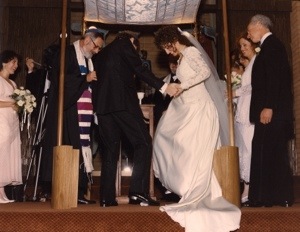
Over the years I have enjoyed seeing Rabbi Annes and Shoshana at rabbinic gatherings, he usually in his tennis gear, she usually selling her exquisite chuppot, talitot and kippot. He will always hold a dear place in my heart as my teacher, my role model, my rabbi.
After moving here to Fresno in July 2011, a group of women from the temple encouraged me to join them cycling. I had done a bit of cycling in college at UCSB, mostly as a means of simply getting around campus and into town. Rick was really into cycling back then and tried to get me into it with varying degrees of success. But I never really became a recreational, let alone long distance, cyclist.
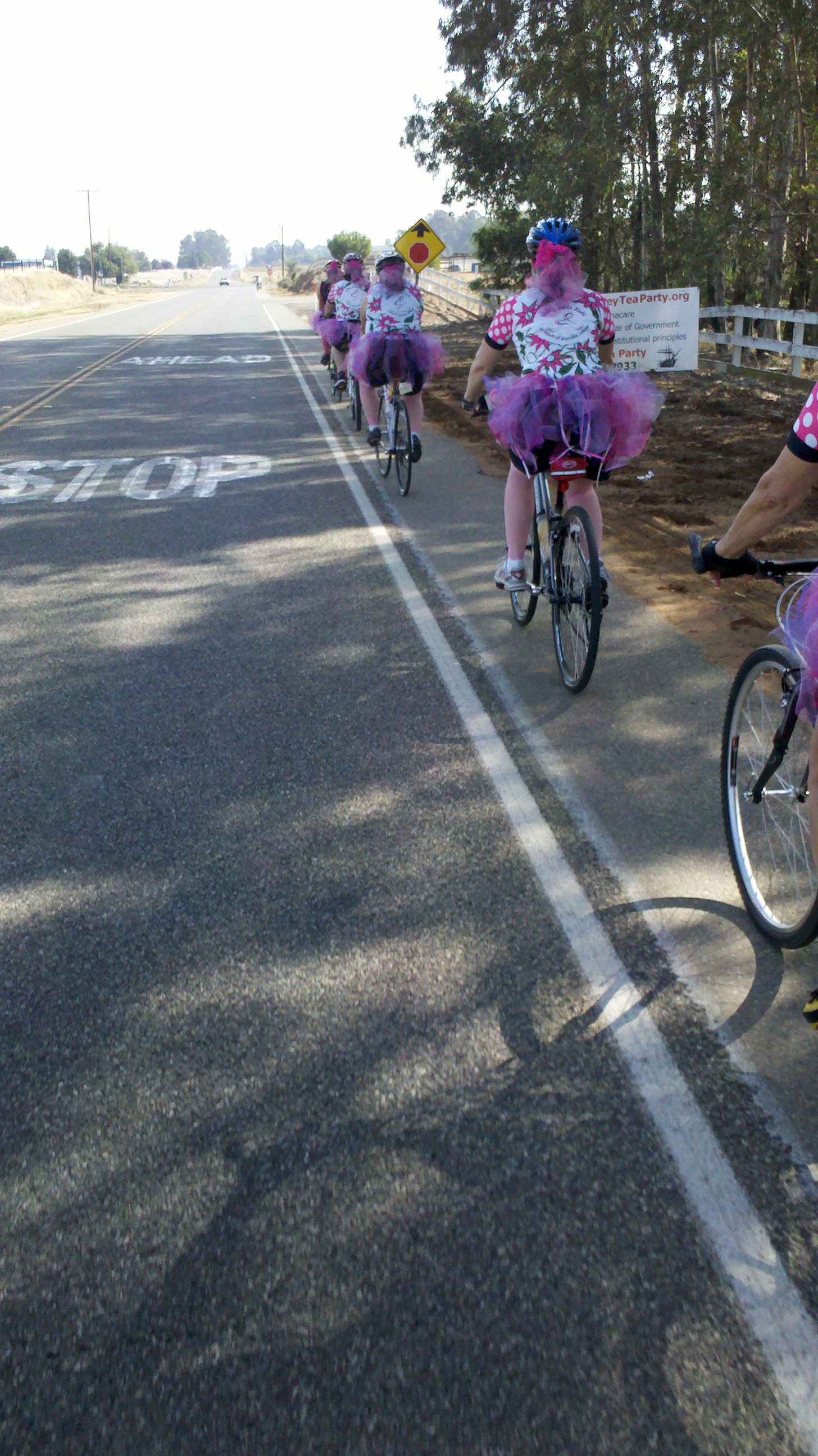 Having now been back on my bike for a year, and riding what I think are good distances (20-30 miles a ride), I have had some time to reflect on the lessons I have been learning as an amateur cyclist.
1. HELMETS PEOPLE! Far too often I see people speeding by me without wearing helmets. What are these people thinking?! The first thing I did when getting back on my bike was buy a new helmet. Safety first!
2.Bal Tashchit – the Jewish value of protecting the environment. Here in the California Central Valley we ride through orchards and vineyards and along gardens. We ride over rivers and creeks. On clear days we see vistas that include the majestic Sierra Mountains. We see lots of animals, wild and domestic – ducks, geese, hawks, horses, “Squirrel!”, dragonflies, herons… Sadly, along the side of the road we see our fair share of roadkill too.
Those who know me know that I am PETRIFIED of snakes. Stop-dead-in-my-tracks-can’t-breathe-can’t-talk scared of snakes. Over the past year I have shared the road with many roadkill snakes and thankfully only 1 live one that we saw crossing the bike path. Thankfully, I did not fall off my bike when I saw it slithering in front of me.
I love to see the flora and fauna of our beautiful state, and I have great appreciation for the beauty of our world. Each time I experience a moment of majesty and beauty I pause and say a short blessing. My new cycling hobby though has pushed me to try to extend that appreciation to those legless/wingless/finless creatures that freak me out so much. Its been a challenge but I am finding my compassionate spot for the unfortunate snake that has met its end along the side of the road.
3. Perspective impacts our understanding of the world. My experiences of the road and the world from the inside of my car and from my bike are so very different. A street that may appear flat from the inside of a car may actually have an incline that would only be noticed when traversing it on a bicycle. I am learning to pay closer attention to the small details of the world around me.
4. Challenges can come from any direction. Here in the Central Valley, you never know what direction the headwind will come from. On one day we could have headwinds coming from north, south, east and west. The wind changes its direction given the hour of the day, the temperature, and probably its mood. We never assume that because we have a headwind in one direction we won’t have it also when we turn around and return. So too, can challenge in life come from any direction and opposite directions. But we must shift gears as necessary and push through.
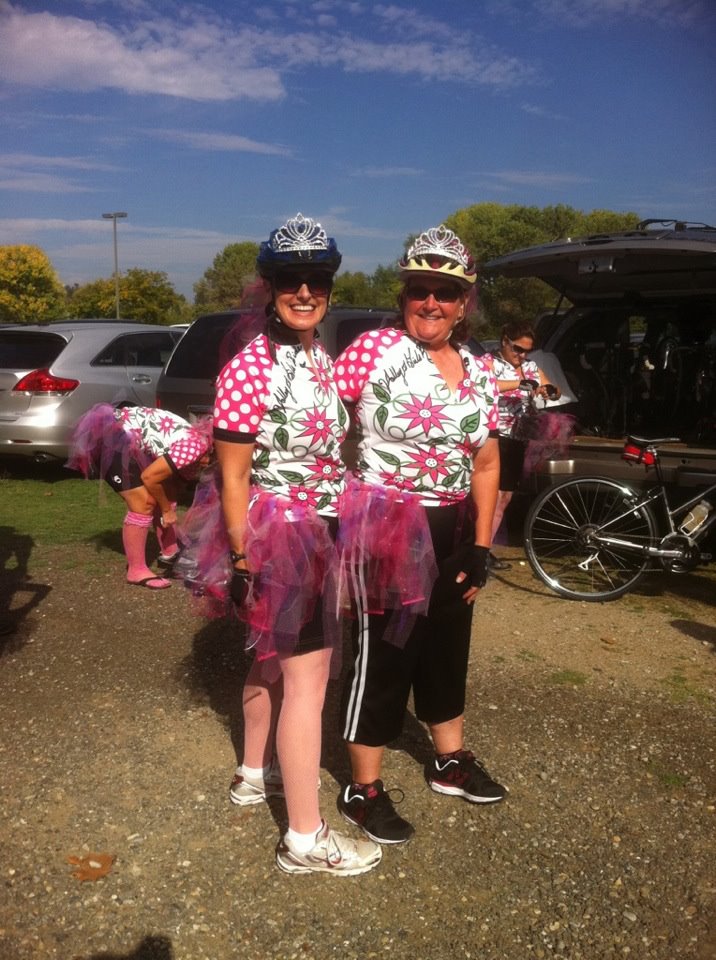 5. Friends help carry us and Don’t be afraid to ask for help. Cycling in a group requires one to learn how to ride as a team. When riding single file, the person in the front of the group actually helps pull the rest of the line along. And when we get tired, or the challenges are just too big to face alone (see #4), ask for help. For surely, if I help you today then you can help me tomorrow.
6. Balance and Always listen to Dad. Last spring I thought I would try to advance my cycling skills by transitioning into clips. After my first try with a friend watching and coaching me, I thought I would give it a try practicing on my own. Long story, short – I fell twice and injured my elbow, leaving me without cycling or other weight bearing exercise for 8 weeks.
At that time my Dad said to me, “What are you thinking? Why do you need these clips? You aren’t running races or anything.” He was of course looking out for me, wanting to make sure I would keep myself safe. Other members of my family said similar things, including my 14-year-old son.
Finally, after several weeks of physical therapy, I got the go ahead to return to my regular exercise routine – especially yoga, which would help me restrengthen my arm. On that first morning back on my yoga mat, I felt like I was coming home to a place that I had missed for a long time. Through that first challenging practice, I realized that I needed to maintain balance in my life. Cycling is fun. I can do it with or without clips and have just as much fun and get just as much exercise. Yoga is important to me too. And other hobbies are important as well. (It’s hard to navigate the kitchen with only one arm as well.) At that moment on my yoga mat I realized that I don’t have to be the best, the fastest, the most advanced in order to reap the benefits of my newfound cycling habit. Balance is what it’s about. Balance the different interests in my life so that I can enjoy all of them.
And, of course, Dad was right.
It seems appropriate that as the festival of Sukkot approaches that I would welcome a guest post to my blog. Sukkot is a time in which we are encouraged to welcome ushpizin, guests, into our home and our sukkahs.
I’d like to welcome my first guest blogger, my dear friend Gabrielle Kaufman. Gabrielle is therapist in private practice in Los Angeles with an expertise in postpartum depression. She runs programs for new moms in both the Jewish community and in the greater Los Angeles community. She is a mom, a sister, daughter, and a very good friend. She has a beautiful way with words. And she offers all of us something to think about as we seal the book of Life and transition to our Sukkot festival.
On Rosh Hashanah it is inscribed,
And on Yom Kippur it is sealed.
How many shall pass away and how many shall be born,
Who shall live and who shall die,
Who shall reach the end of his days and who shall not…
I sit across from Rachel (not her real name). She has been my client since a few months after the birth of her child, 4 years ago. Rachel is an observant Jew. She has tears in her eyes today, the day after Rosh Hashanah. Her guilt at having driven to synagogue this holiday eats at her. But so does her crippling depression. Rachel has never fully recovered from her postpartum depression. Sure, she has come to find meaning in her life as a mother, but her isolation, marital struggles, low self-esteem and anxiety continue to limit her greatly. Over the years, I have seen Rachel in moments of great pain, plagued by suicidal thoughts. In a few short years, she has suffered the loss of her mother, a home robbery, health setbacks and financial ruin. She has agonized at having to care for babies when she was lost and lonely. Yet, I have also seen her beam in triumph as she has successfully fought her demons and found joy in her young children. She has been in therapy, on medication, attends a parenting class. In truth, as her therapist, I feel at times that helping her is beyond my reach. I share my concerns with her psychiatrist who recognizes the fragility of our shared client’s mental stability. And right now, Rachel utters something that shakes me to the core again.
 “I know that you probably don’t want to hear this. But yesterday, in shul, I heard the unetaneh tokef prayer and thought, ‘it’s okay, God, if this is the year I don’t survive. It is okay if I die.’” She was right, I didn’t want to hear it but I did. Quietly, I hold space as Rachel talks of her struggles and sadness. In my own mind, I wonder what to do with her passively ‘suicidal’ thought. I don’t have the answers. As I witness the sadness, without criticism, she begins to move to a new topic. Though I was relieved, I knew I had to address her comment.
Then, with 3 minutes left of our 50-minute session, something comes to me. There are many ways to look at death. Having seen Rachel’s pain over the past years, I do not envy her life. I can understand not wanting to continue this existence of pain. It makes sense that she is ready to give up. “Perhaps, your thought is not to actually die, but to have the depression in your life die. Perhaps, you want to start a new life, a life where you are not in the depths of despair (a fate worse than death). Perhaps you are finally ready to be part of the lot that God chooses to fully live.” Her posture lifts and her facial muscles change. “I like that,” she says quietly.
Now our hard work begins.
#BlogElul 26 – Readiness
 As a non-congregational rabbi, and the wife of a congregational rabbi, my High Holy Day preparations have less to do with sermon writing, cue sheets and making sure everyone knows their Torah portion. My preparations have more to do with making sure my family has some quality time together in between the various congregational services Rick leads and we attend. My preparations have to do with food.
In Pirke Avot we are taught “Im ain kemach, ain Torah, without food (literally flour), there is no Torah.” If we think about this teaching in Maslow’s terms, we need our basic needs of sustenance met before we can be open to receiving the wisdom and guidance of Torah. I like to think of myself as the one providing the kemach, the sustenance, for our family during this season, while Rick is the one providing our community the guidance of Torah and Judaism.
 So a big part of my getting ready for the High Holy Days is preparing my menus and shopping list. I gather some of my favorite Jewish cookbooks around me, sometimes spending hours perusing them. I look back at past menus to see what I made last year or the year before. Of course I always have some favorites that I make every year. And each year includes at least one new recipe.
My time spent in the kitchen preparing our holiday meals is very much a spiritual practice for me. I sometimes put on Jewish music, or put on a movie with an appropriate theme. I get in my groove. The tastes and aromas are powerful triggers for me. I reflect on the year that has passed. I contemplate the year ahead. I have imaginary conversations with family members who are no longer with me yet continue to guide, inspire and strengthen me. Sometimes I even shed a few tears. I enjoy the time alone.
When the time comes for us to sit down together to eat, I am usually exhausted. But it is that good kind of exhaustion.
I am usually the last one to sit.
I take a long, slow, deep breath.
I look around the table at my dear family.
As we sing the blessings, pass around the dishes of food, and dig in, I am happy.
I am blessed.
#BlogElul 25 – Forgiveness
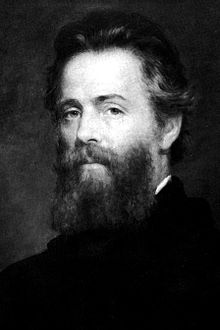
I’ve done quite a few road trips this month with my 20-year-old Saul. We decided it would be fun to get an audio book for the drive. Browsing around the iTunes store I came across an inexpensive unabridged audio of Moby Dick by Herman Melville. Given that whales are a particular interest to Saul (especially the orca), that it’s a classic that neither of us had read, we went for it.
I didn’t realize how funny a book it is. My favorite line so far is, “He was a kind and comely cannibal.” (Ishmael referring to Queequeg upon getting to know him that first night in the Inn, sharing a bed.)
I didn’t realize how monotonous it would be. Saul’s comment: “He sure is long-winded.” (Referring to Melville, during one of the very long tangents on the color white and its symbolism in various cultures). Already we’ve taken 2 round trip road trips and haven’t finished the book yet…though we do take breaks from the story for some music.
I didn’t realize how appropriate Moby Dick is for this month of Elul. It’s a story about faith. It’s a story about trust. It’s a story about memory. So many of our #BlogElul themes. There is even a sermon about Jonah, given by a pastor on a Sunday morning in Nantucket before the Pequod sets sail.
And of course its a story about revenge and forgiveness. Having not finished the book yet, I don’t want to comment on the final messages Melville leaves us with, but I do want to reflect on some questions it has raised for me about revenge, pain and forgiveness:
- How can we forgive someone who just isn’t capable of recognizing the harm they have done to us?
- When so focused on one task or issue,- or as Melville has taught me, when one has monomania, especially one as all-encompassing as revenge – what and who else suffers in our lives? How can we move ourselves or others beyond that monomania?
- When we perceive we have been hurt by someone else – how often is that perception accurate? Should we look ourselves in the mirror and see how maybe we brought that pain on ourselves through misinterpretation, misunderstanding or narrow-mindedness?
These are some very BIG questions. Perhaps we can contemplate them together in the coming Days of Awe. I am going to try to…along with finishing Moby Dick.
Tonight was Back to School Night at University High School. As Back To School night spiels go, at first glance it was nothing new. Ten minutes in each class. Teachers talking about their curricula, homework, grading scales. Parents asking the same questions: “Can my son use a calculator?”
What was unique and refreshing was the excitement and passion in the teachers’ eyes. The relative tenures of the teachers crossed the spectrum: some are at the relative beginning of their careers; some have been teaching for 30+ years. Each and every one of the teachers I met though shared a level of enthusiasm for teaching that was infectious. All of them love teaching at UHS – I could see it, I could feel it.
For the first time in a long time I heard well a articulated rationale for how and why the curriculum was developed. I lost count of how many times I heard the teachers say they were trying to teach for “understanding”…not just for facts, not just to standardized tests. My two favorite quotes of the evening:
I practiced music non education for more than 20 years, then I came to teach here at UHS.
We are putting the education back in physical education.
And those were the “less academic” classes – though all classes at UHS are rigorous.
As an educator, I have thought a lot about the kind of high school experience I wanted for each of my boys. I dreamt about a school in which
– he was safe to be himself
– he could be in small classes and build meaningful relationships with his teachers and peers
– there would be diversity in the student body and an appreciation of that diversity
– he would be able to identify, embrace and thrive in developing a passion or a talent
– he would be surrounded by adults who care about him, support him, and are excited to be at school every day (well, maybe most days) with him
– together with peers, teachers and administrators, he would be part of a community built around values of mutual support, respect, appreciation and a commitment to learning.
– he would be excited about going to school and still be excited to tell me about it at the end of the day
I think we have found it.
Sitting in Shabbat services last night, I noticed something in the Mishkan T’Filah siddur (prayerbook) that hadn’t caught my attention before.
Rabbi Rick had invited the congregation to read the Emet v’Emunah prayer together in English (pg.156). This prayer is recited immediately following the Shema and is about God’s redemption of the Israelites from Egyptian slavery. It recalls that moment of freedom and well as looks forward to future redemptions. About 2/3 of the way through the passage we read,
You led Your people Israel out from their midst to freedom for all time.
When Your children witnessed Your dominance
they praised Your Name in Gratitude.
Dominance?
I had never noticed this word before. Dominance? Do Jews really think that God is dominant?
I turned to the Hebrew.
Vayotzei et amo Yisrael mitocham l’cheirut olam.
V’rau vanav g’vurato,
shib’chu v’hodu lishmo.
Your dominance = g’vurato. Gevurah is a common word in our liturgy. Usually it is translated as “might” or “strength.”
I perused other parts of the siddur to see how other instances of gevurah were translated.
- The Gevurot prayer (p.168) – Ata gibor l’olam Adonai = You are forever mighty
- Nisim b’chol yom (The Morning Blessings) (p.40) – Baruch Ata, Adonai Eloheinu, melech ha’olam, ozer Yisrael b’givura = Praise to You, Adonai our God, Sovereign of the Universe, who girds Israel with strength.
- Ashrei, Psalm 145:1-21 (p 52-54) – Dor l’dor y’shabach ma’asecha, ugvurotecha yagidu. = One generation shall laud Your works to another and declare your mighty acts. K’vod malchutca yomeru, ugvuratecha yedaberu. L’hodi’a livnei ha’adam g’vurotav, uchvod hadar malchuto. = They shall talk of the majesty of Your sovereignty, and speak of your might, to make God’s mighty acts known among mortals and the majestic glory of Your sovereignty
I thought about a familiar passage from Pirke Avot 4:1 – Ayzeh who gibor? Hakovesh et yitzro. Ben Zoma said, “Who is strong? He who conquers his evil inclination…”
I thought about the lyrics made famous by Debbie Friedman z’l, “Not by might, nor by power, but by spirit alone…” from Zechariah 4:6. The Hebrew there is actually different. Lo b’chayil v’lo b’ko’ach ki i’m b’ruach... Chayil has the connotation of military might.  You get the point. No where else did I discover gevurah translated as dominance.
So. why here in this one prayer? Did we really believe that at that moment of redemption from Egypt, as we were about to cross over the sea, that God is dominant? I suppose when we place this prayer in the context of the moment of our freedom, we could view the God of Israel as dominant. The Egyptians had challenged Moses and Aaron to prove that their God was more powerful than the Egyptian gods. That is why God brought about the plagues, working miracles to prove that the God of Israel was mightier/stronger/dominant over the Egyptian magicians and gods.
 Yet, as we continue to pray for redemption from bondage – what ever that may mean to us today – do we still hold a belief in God’s dominance? I don’t. I like to believe that while my God – the one I believe in – provides me strength, and guidance and protection – that the God you believe in may do the same thing for you but in very different ways. For each of us God takes a different shape, a different meaning and role in your life. There are many paths to God. My path is not dominant over yours, nor is yours over mine. My God does not dominate over yours, nor does yours dominate over mine.
#BlogElul #10 – Memory

Seven years ago this week Hurricane Katrina slammed into the Gulf Coast. The memory of the devastation, pain, fear, heroism, hope, disappointment and generosity is still very fresh in many of our minds, especially those who lived through it. Today our thoughts and prayers are once again with the residents of the region, as we anxiously await Isaac.
Though I did not personally live through Katrina, I experienced her devastation in the aftermath.
In the wake of the hurricane, dear friends and colleagues David Berkman and JC Cohen, each a URJ Camp Director, rallied our Jewish community together to provide support, supplies and assistance to those who we impacted by Hurricane Katrina. The Jacobs’ Ladder Relief Project was born. The amount of food, toiletries, supplies that passed through the Jacobs’ Ladder collection center in Utica, MS was staggering.
I had the honor of spending the week of Yom Kippur in Utica working on Jacobs’ Ladder. Each day I would take calls from churches and centers housing evacuees. I would ask, “What can we send you? What do you need?” Each day I would unload truck loads full of donated supplies coming in on pallets from across the country. I learned how to drive a forklift and a pallet truck. Each day we would sort the donations around the warehouse. Canned goods & non perishable foods took over one-third of the space. Toiletries and first aid supplies took over another third. Diapers (infant and adult) were along the back wall. Each day we would put together pallets of supplies to send out to those in need. On Yom Kippur we took a break from our work and prayed for healing and redemption.
So many memories from that week flow through my mind’s eye today.
I remember driving the Pensky truck full of food and supplies to that small church in Enterprise, MS. Shelley Schweitzer and I were greeted by the community with open arms. While the men unloaded the truck, the women ushered us inside for lemonade and snacks, and the children danced around excited to see what was delivered. We gathered together in a prayer circle, hands joined, black and white, Jewish and Christian, thanking God for the generosity of those who donated the much-needed food, thanking God for delivering Shelley and me safely to them, imploring God to return us safely home to our families.
I remember the pain and need – the families who lined up for hours outside our collection center to pick up bags of supplies.
I remember the unending generosity and good will of our nation. I remember the medical professionals who dropped their private practices to come south and provide much-needed care. The truck drivers to dropped their usual routes to help bring supplies in and out of the region. The regular people who felt so pained by the devastation, who had such big hearts to donate their own time and money and energy to help out wherever and however they could.
Memory is a powerful thing. It is what sets us apart as human beings.
Painful memories can hold us back, keep us stuck in the past or they can urge us forward to a different future. Positive memories bring us warm feelings of love, laughter, joy.
In Jewish tradition, when someone dies, our words to the mourners are often, “May their memory be a source of blessing and strength to you and your family.”
Memories can inspire growth and change. Memories can move us toward transformation.
During this month of Elul, our work should be recalling the memories of the past year. How can we learn from them. What do we want to treasure? What do we want to change for the coming year?
Today, as Isaac blows toward Louisiana and Mississippi, I pray.
May the memory of Katrina bring us strength. May we have the strength to face the fear and flooding coming our way. May we have the strength and wisdom to join together as a nation to help those impacted – not just in the days ahead but also for the long-term. May we have the strength to led a hand to those near and far-reaching out for help. May we each, in our own way, find the strength and inspiration to act, to create change, to bring healing to those in pain. Hazak, hazak v’nithazek – be strong, be strong and we will be strengthened.
 Rabbi Laura