
Its a fun party game…
If you could have dinner with anyone, alive or dead, who would it be?
At this time of year, during Sukkot, we call that the mitzvah of ushpizin – welcoming guests into the Sukkah. Each night, it is a mitzvah to welcome friends and family, those whom we love, into our sukkot as honored guests.
Additionally, we symbolically invite those no longer with us into our sukkot, those we remember, those we miss, those we admire. From this group of ushpizin, here’s my guest list for the year:
– My grandmother Ruth May Novak is always an invited guest. She passed away a couple of years ago on Erev Sukkot, so I especially remember her at this time.
– Of course my other grandparents are invited too. Ruth’s husband, my “friend” (it’s a story of another time, Elmer Novak. And my maternal grandparents Nanny Rose and Papap David.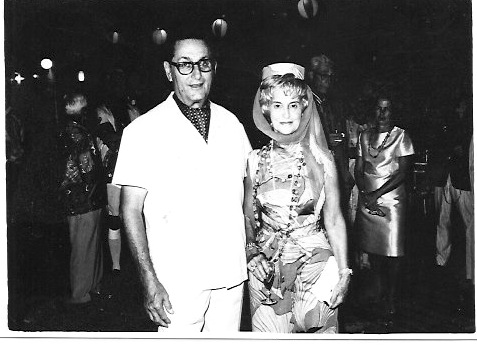
– I’ve been thinking and reading a lot about John Dewey.  I’d like to have him join me one evening for some conversation about meaning and experience. It would be interesting to have Abraham Joshua Heschel join us for that conversation. I think they’d get along.
– From Israel, I’d like to invite David Ben Gurion to do some yoga with me in my sukkah. We’d talk about peace and about the land that we love so deeply.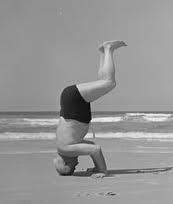
– Of course I’d always like to have Rabbi Tarfon. He’s my favorite Rabbi from the Talmud. We talk about social justice and the need to do the work, even though we can’t complete it.
– Finally, I’d invite some of my teachers from when I was growing up, especially Mrs Block, Mrs Truitt, and Mrs Stern – they were the ones who really worked hard and succeeded at keeping us engaged. As a doctoral student in education, it would be fun to sit and talk with them about their visions for education and teaching and learning.
Each year we find ourselves in different places in our lives, thinking about different things. My guest list clearly reflects where my head is these days.
Who would you invite?
Moadim l’simcha – may this time be one of joy and happiness for us all!
As I took a short walk this afternoon during a break between Yom Kippur services, a memory, both humorous and deeply emotional, flooded my heart.
I realized that my rebellion against fasting began as a teen. That rebellion was supported by an adult who was a very influential person to me, especially in my teen years.
It won’t be a surprise to many that as a teen I was a “temple geek.” I loved being at temple with my friends, in youth group, in religious school and Hebrew High. But I was also a normal teen who tried to ditch classes during break and who got bored during High Holy Day services.
My parents, very active in the congregation had lots of friends in the community, many of whom I had grown up with. One dear friend, Warren Estrin z”l, was often an usher during those High Holy Day services. He too got restless and, dare I say, bored.
One Yom Kippur, as I got up to take yet another walk, Warren pulled me aside and whispered in my ear, “Come on, let’s get out of here.” We quietly exited the sanctuary, climbed into his car and drove around the corner…to the donut shop. 
Thus began a short-lived ritual (until I left for college) and a decades long source of connection and inside jokes.
As irreverent as Warren and I were in those brief moments when we snuck away, they actually had a tremendous impact on my connection to Judaism and our Jewish community. Those moments together at Winchell’s Donuts over chocolate old fashioneds and apple fritters were moments in which Warren reached out to me like an uncle, like an adult who cared and wanted to support me. We talked about my life and what was important to me, we talked about my relationships with friends and peers, we talked about what these holy days meant to us.
Remembering these times now raises mixed emotions. I am sad – because Warren is no longer with us. I am nostalgic – for those more spontaneous days of my youth. And I am hopeful – hopeful that I can take the example that Warren set for me in reaching out and making the difference in the life of a young teen.
I have a confession to make. I suppose, given that Yom Kippur, the Day of Atonement, begins tomorrow night, it is appropriate that I do so. Much of our Yom Kippur liturgy involves confessing for sins we have committed in the past year.
But, my confession isn’t really for a sin. Rather it’s probably more of an admission. Here goes…
I don’t fast on Yom Kippur.
You’re probably thinking that’s not a big deal – lots of people don’t fast. Pregnant women and aren’t supposed to fast. People who are required to take medications on a full stomach don’t fast. The elderly really shouldn’t fast. Well, I don’t fit into those categories.
But it is actually quite a big deal. The tradition of fasting on Yom Kippur dates back to the Torah.
Leviticus 23:27-29: “Mark the tenth day of the seventh month as the Day of Atonement. It shall be a sacred occasion for you; you shall practice self-denial… For it is a Day of Atonement, on which expiation is made on your behalf before the Lord your God. Indeed, any person who does not practice self-denial throughout the day shall be cut off from his kin.”
We are supposed to fast in order to show our full remorse and to be cleansed for the sins we have committed in the past year. And if we don’t fast, as Torah says, we should be cut off from our community. That’s pretty serious.
I don’t fast because I don’t believe in it.
Granted fasting is not an easy endeavor. Twenty-five hours without food or water is not easy. But does it really cleanse my soul of the errors and dreck of the past year? No. For me true cleansing comes from admitting to myself, to those I have wronged and to God the mistakes I have made. True repentance comes when committing not to make those same mistakes again – and when faced with the opportunity to do them, not.
On Yom Kippur we read from Isaiah 58, where the prophet redefines the fast we should be doing:
No, this is the fast I desire: To unlock the fetters of wickedness And untie the cords of the yoke To let the oppressed go free; To break off every yoke. It is to share your bread with the hungry, And to take the wretched poor into your home; When you see the naked, to clothe him, And to not ignore your own kin.
Isaiah teaches us that our spiritual work should be focused outward – toward those in need. From there will come our cleansing and healing.
As a Reform Jew, I make informed and thoughtful decisions about my Jewish observance. After years of reflection, experimentation with fasting, I know it doesn’t work for me. So, as Yom Kippur arrives tomorrow night, while I will not be fasting, I will pray and I will meditate. I will join together with my community in communal confession. I will contemplate how to make this world a better place and myself a better person. And as Yom Kippur ends, I will take action.
As a non congregational rabbi, the end of Elul is a different type of busy for me. Cooking.
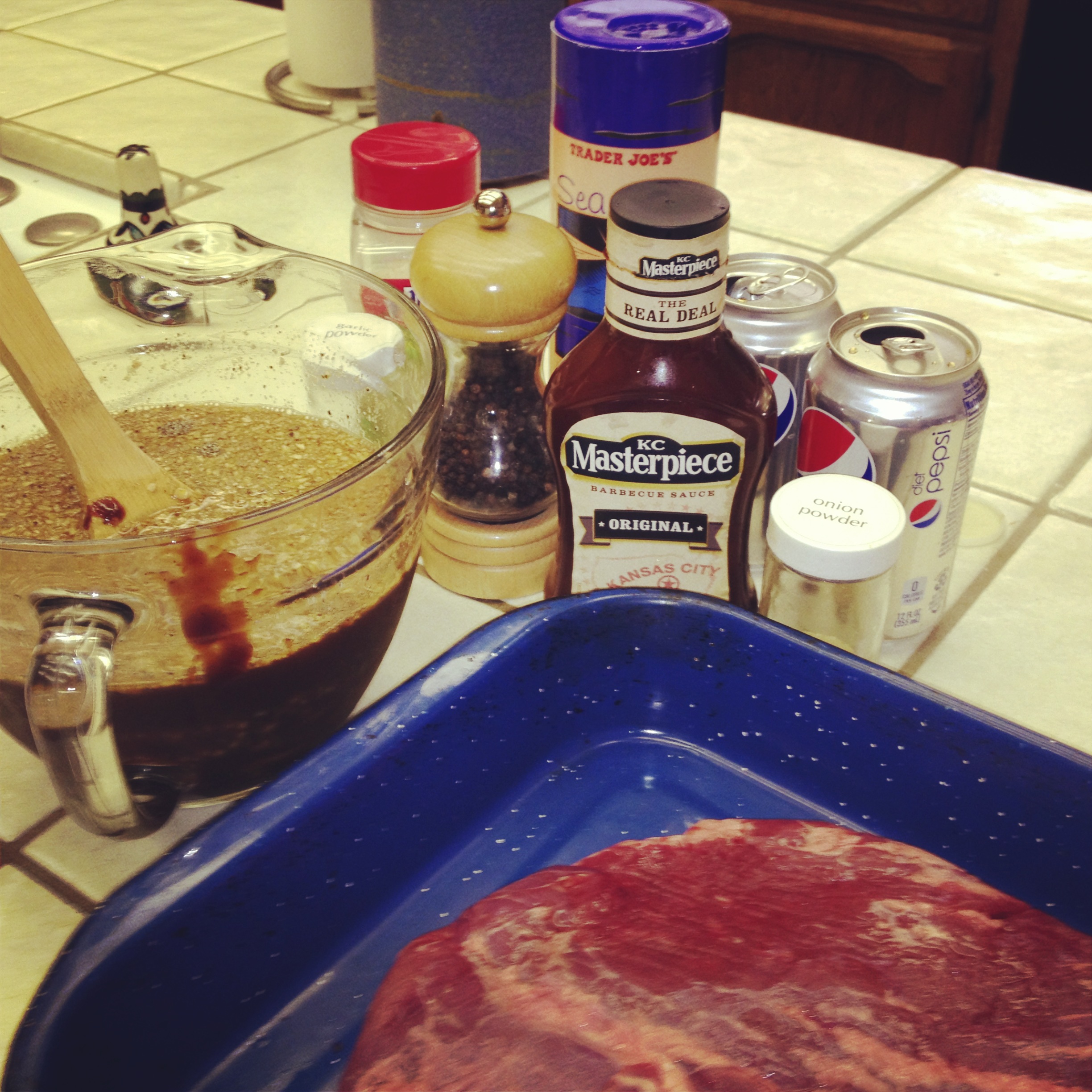 It is time for the brisket to go into the oven.
Searching through cookbooks and Pinterest pages, today I began crafting my Rosh Hashanah menus. My family teases me that I always find ways to experiment with new recipes. I don’t like to serve all the same items every year. That is, except for the brisket. I make the same brisket every year. I wouldn’t think of changing it! While I like to try out new flavors and tastes to accompany our Rosh Hashanah experience, a little bit of the “traditional” goes a long way.
As I enjoyed the aromas of the brisket slowly cooking in the oven this morning, I reflected on the idea that Elul is coming to an end. I realized that one of the beauties of our Jewish ritual is that we never really reach the end – as in we never get to come back to it again. We always eventually circle back to where we once began. Ben Bag Bag teaches in Pirke Avot, “turn it and turn it again for everything is in it.”
Each time we re-turn to Elul , we are once again called to do the work of this High Holyday season. And as this Elul nears its end, we know that it will return again. What we might not have accomplished or finished this month, we can continue. We grow, we change, we see things from a new perspective each year. We always have work to do.
Today I realized that while I might return to the same brisket recipe every year, our family experience of it changes. We are different people than we were last year. We are new. We are renewed.

I am troubled.
The Syrian government has allegedly used chemical weapons against their own innocent citizens.
There has been so much violence in Egypt that its hard to tell who are the good guys and who are the bad guys. At this point, it doesn’t seem like either option is a good one – considering they both seem to feel its okay to kill those who speak out against them.
In Yemen a video of an 11-year-old girl went viral as she spoke out against her own mother for selling her into an arranged and probably-soon-to-be abusive marriage. Her own mother! This is not a unique case.
And here in the states we continue to fight for the right to vote (North Carolina!), to end gun violence (Atlanta!) and to end misogyny and sexual harassment (San Diego!).
Yet, what was one of the most talked about issues in the twittersphere and on the morning talk shows this morning – that Ben Affleck is going to be a crappy Batman.
Come on people! Wake up! Pay attention to what’s important in this world!
I am reminded of the verses we recite on Rosh Hashanah, during the Shofar service:
Awake, you sleepers, from your sleep! Rouse yourselves, you slumberers, out of your slumber? Examine your deeds and turn to God…
I pray that as we prepare ourselves for the Days of Awe, we will strive to turn our attention to matters of justice, matters of life and love and peace, matters that will contribute to healing to our broken world.

Are you a paperclip or a stapler?
My dear friend Melissa Anton Frey, Director of the URJ Kutz Camp, never uses paperclips. It has been a source of ongoing humor and numerous conversations between us. Why, might you ask, does she avoid the paperclip? Because, she believes, we have to commit.
Paperclips are temporary. They can easily be removed. Paperclips are emblematic of a lack of commitment.
Staples, on the other hand, require conviction. They ask you to make a commitment to what you are doing.
Thinking about the challenges of change, I was reminded of this paperclip vs stapler debate. It occurred to me that we each approach change as either a paperclip or as a stapler.
The paperclip approaches change tentatively. The paperclip has an escape, can turn back if things aren’t going as desired.
The stapler jumps in to change. The stapler is all in and will stick to it not matter what. The stapler will see things through till the end.
Change is hard. Whether its moving, leaving a job, making a transition in a relationship, or even something as simple as getting a new hairdo. It can be scary. It can be invigorating. It can lead us to question and doubt. It can be grounded in faith and assurance.
Are you a paperclip or a stapler?
I like to think of myself as a lifelong learner. I’m always thirsty for learning.
Some years I’ve had the luxury to give myself the time for learning. Sadly, setting aside time for learning is framed as a “luxury.” It is something I feel guilty about. “I shouldn’t be sitting here reading when there is _________ to do.” Some years I succumb to the self-imposed sense of obligation to whatever that fill-in-the-blank thing is, going months without cracking open a book or exploring a new idea. Don’t we all?
As I reflect on 5773, as it is coming to a close, I am thankful for the varieties of learning I did. I am grateful for my teachers and the opportunities I’ve been afforded. This year I learned a lot.
I joined a study group of Jewish educators exploring the teachings of John Dewey and his definitions of experiential education.
I read 12 books I probably never would have selected but loved. My eyes were opened to the beauty of each book through the perspective and life experience of an amazing and diverse group of women whom I treasure learning with in our monthly book group meetings.
I learned – and am still learning – how to be a good mentor.
I learned how to spin. At my first spinning class the instructor asked me if I “spin.” “No,” I said, “I ride my bike outside.” Well, now I do both.

I learned how to ocean kayak. Thanks Deb! My sister is always one to challenge me to try new things. She’s always been the fearless twin.
I’ve learned to let go. To hold on. To jump in. To stand back. To speak up. To sit back and listen.
It feels really good to reflect on the year that has passed, to take account of what has been. That is part of my cheshbon nefesh.
I’ve been on a bit of a cleaning kick lately. This weekend, when I wasn’t spending time with my boys, I was a whirling dervish spinning around the house cleaning out and clearing out. I relieved the refrigerator of expired salad dressings and condiments (you would Passover was approaching, not Rosh Hashanah). I organized and refreshed the spices. 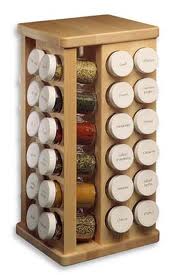 Upon opening a box of miscellaneous craft supplies, I had to take 10 minutes to recycle scraps of craft paper that are just too small to be of use and toss all those dried out fabric markers. I finally made an appointment with the consignment store to take in the first batch of Fall clothes that I am hoping to resell. The laundry is being done as I type. And my desk is now cleared of all stacks of paper. You get the picture!
Frankly, I have a long list of summer projects I had intended to complete. Now that school has started, and Elul is here, it feels like summer is quickly on its way out. Maybe my cleaning kick is a last-ditch effort to hold onto summer and the hopes of crossing more off of the list.
Or perhaps I am procrastinating. I do have work to do. Reading to catch up on. I like using my Sundays for house projects rather than work projects and tasks. Otherwise they just never get done.
This I know about myself: I cannot think clearly or focus unless I make the physical space to do so. Since my high school years I have had to clean my room and my desk before I could actually sit down to do my home work. What’s the old proverb? A clean desk is the sign of a sick mind.” In my universe, a clean desk is the sign of an open mind.
Each of these little organizing tasks is my way of making space – both physical and spiritual – in my mind and my heart and my house so that I can have room to do the work I need to do. That work may be one of my various consulting projects. It may be studying for one of the online courses I will be taking this year in my doctoral program. It will surely be the work of cleaning off my slate from this past year and figuring out how to refresh, renew and begin again. 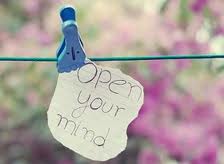
Though it isn’t one of the “official” #BlogElul topics, today I have been thinking about cleaning and clearing. I invite you to reflect with me:
- What has been holding onto you that you need to break free from?
- What have you been holding onto that is now time to let go?
- What are you hoping to clear out holding onto you that you need to break free from?
- How do you open your heart and mind?
- How are you going to make space in the coming days so that you too can create openness and receptivity to the messages and work of our High Holy Days?
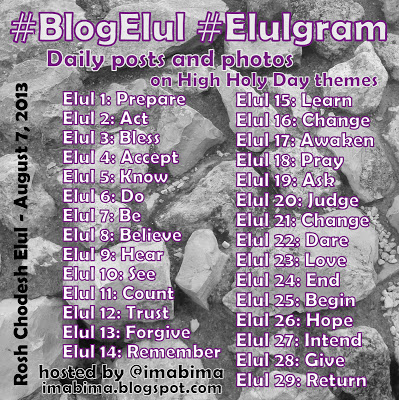
As a non congregational rabbi, some might think that preparing for the High Holy Days would be easier for me. I don’t have sermons to write, services to prepare, logistics to oversee. That is relatively true. My work slows down this month as my rabbinic, educational and cantorial colleagues put their minds toward Tishri.
As the wife of a rabbi, my preparation work in Elul is usually focused outward.
- Making space for my husband to do his work
- Preparing comfort food and making sure his favorite late night snacks are on hand
- Covering perhaps some additional portions of child-schlepping
- Channeling my own stores of patience and compassion. He will be very busy, pre-occupied and focused on the needs of his congregation at this time. Now is not the time to ask for new projects to be completed around the house. (Unless of course, he is the mood to procrastinate or needs a break)
In all reality, taking the month of Elul to prepare for the Yamim Nora’im (Days of Awe) is challenging for everyone. It is supposed to be. Each morning the shofar calls us to begin our heshbon hanefesh (spiritual accounting). We begin a marathon period of self-reflection, doing the hard work of t’shuvah (repentance), and re-booting for the coming year.
It is hard to do this work on your own. In the past I have considered using a guide to help me with this work. A quick check on Amazon elicited several “preparing for the high holy days” books.
Preparing Your Heart for the High Holy Days by Dr. Kerry M. Olitsky
This Is Real and You Are Completely Unprepared: The Days of Awe as a Journey of Transformation by Rabbi Alan Lew, z’l
60 Days: A Spiritual Guide to the High Holidays by Simon Jacobson
Whether it is with one of these books, or with my own process of reflecting, I am going to try this month to really do the work of preparation that Elul calls upon. It will be hard. It will take commitment and stamina. Ultimately, I hope it will enrich my High Holy Day experience and lead to my own personal growth.
May this Elul be one of meaning and introspection for us all.

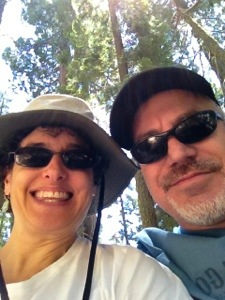
A day hike with my best friend.
Butterflies, orange, yellow, white, blue playing tag in the wild flowers
I wish I knew their names
Majestic Sequoias surrounded by a carpet of ferns
Silence
The only sounds the echo of our footsteps on the dirt and granite
The calls of unseen, unknown birds
The wind winding its way through the branches of the tall, tall trees
The click of the shutter on his camera
We inhale the clean, clear air infused with the freshness of pine needles
We are surrounded by the silver gray of the granite canyon
It hugs us close
The falls of Tokopah draw us up
Till we find the water gracefully, coolly running down
 Rabbi Laura